
Solar Panel Away From Fan: Your Ultimate Setup Guide for Shaded Patios That Need Sun
Learn how a solar panel away from fan setup solves shaded patio charging problems. Discover where to place your solar panel, what features matter, and how to choose the right solar ceiling fan for pergolas, gazebos, and covered outdoor spaces.

Is a remote-panel setup the right fix for your shaded patio?
A shaded patio can feel perfect at noon and useless by dinner. The roof keeps the space cooler, but it also blocks the sun your solar ceiling fan needs most. That mismatch leads to weak daytime charging, shorter evening runtime, and a setup that looks right on paper but underperforms in real life.
The better answer is often simple: keep the fan where comfort matters, and move the panel where sunlight actually reaches. That is the logic behind a split-placement system, sometimes called a solar panel away from fan setup. In the sections below, you will sort out how these systems work, where the panel should go, which features matter most, and how to match a no-wiring ceiling fan to your shaded patio, pergola, gazebo, or shed.
How these systems work before you choose one
A remote-panel solar ceiling fan only works well when the whole system makes sense together. You are not just buying blades and a panel. You are planning energy collection, storage, and airflow as one layout.
The core idea behind a split-placement solar ceiling fan
In this setup, the fan goes where you want cooling and light, while the panel goes where the sun is strongest. That matters because many covered patios, pergolas, and gazebos are comfortable precisely because they stay out of direct sun. A standard all-in-one solar-powered outdoor fan can struggle there, but a split layout gives you more freedom.
The basic system usually includes:
- A fan mounted under a covered ceiling
- A solar panel mounted in a sunnier location
- A battery that stores charging power for later use
- A cable connecting the panel to the fan system
- A controller that manages charging and power delivery
With Ventallion’s outdoor solar ceiling fans, the panel can be placed separately for better exposure, and the system uses LiFePO4 battery storage to support after-sunset use.
Terms that matter when comparing setups
A few terms tell you whether a model is built for shade-friendly installation or just marketed that way.
- Remote panel placement: the panel can mount away from the fan instead of directly above it.
- Battery backup: stored power keeps the fan running when sunlight drops.
- LiFePO4 battery: lithium iron phosphate chemistry, known for thermal stability and long cycle life.
- Covered-use fan: designed for sheltered outdoor ceilings rather than fully exposed open-sky mounting.
- Runtime range: expected operating window, which changes with speed and light use.
- Flexible cable: the longer connection lead that gives you more panel-mounting options.
These details matter because shaded installations usually fail from poor energy planning, not from fan size alone.
The main setup types for shaded outdoor spaces
Most split-placement layouts fall into a few repeatable patterns. Once you identify yours, the panel location becomes easier to plan.
- Fully shaded roof, sunny fence: common in small patios or side-yard seating areas.
- Shaded pergola, sunny house roof: useful when the main structure sits under trees.
- Covered patio, open yard edge: good when the yard gets midday sun but the ceiling never does.
- Shed interior, exterior wall panel: ideal for storage or work areas that need an off-grid ceiling fan.
If your space fits one of those patterns, a remote-panel layout is usually more practical than trying to force a panel into permanent shade.
Where should the solar panel go if the fan stays in shade?
Panel placement decides whether your solar ceiling fan feels dependable or frustrating. Even the best fan with battery backup cannot store power it never receives. So before you think about blade span or finish color, map the sunlight.
Best mounting zones for stronger charging
You want the panel in the cleanest, longest daily exposure you can reach without creating a messy cable route.
Good mounting zones often include:
- Roof edges with open sky exposure
- Fence lines that face the strongest sun window
- Pergola beams that extend past the deepest shadow band
- Wall sections that get reliable midday light
- Ground stands in open yard areas
Ventallion’s compatible charging layouts support separate panel placement, and its extra solar panel accessory includes a 5-meter cable to widen placement options for covered patios, pergolas, gazebos, sheds, and barns.
Shade-check workflow before installation
A quick site check saves a lot of guesswork later. Instead of relying on one sunny photo, track how the space behaves across the day.
Use this workflow:
- Check the site during morning, midday, and late afternoon.
- Mark where direct sun lasts the longest.
- Watch how tree shadows move, especially in summer.
- Note obstructions like beams, gutters, railings, and nearby walls.
- Measure the cable route before choosing the final panel spot.
- Confirm the panel can sit at a useful angle and stay clear of runoff.
The U.S. Department of Energy notes that ceiling fan performance and efficiency are tied to proper application and setup, which is a good reminder that location matters as much as equipment choice in real use cases DOE.
What to avoid in remote placement layouts
Some panel locations look convenient but reduce charging enough to hurt evening performance.
Avoid these common mistakes:
- Deep shade through most of the afternoon
- Dense foliage directly above or in front of the panel
- Sharp cable bends near brackets or corners
- Long, loose cable runs without clips or protection
- Low spots where water tends to pool
- Easy-to-bump areas near gates, tools, or stored equipment
If your best-looking panel position gets only broken light, it is usually better to move it farther and charge well than to keep it nearby and charge poorly.
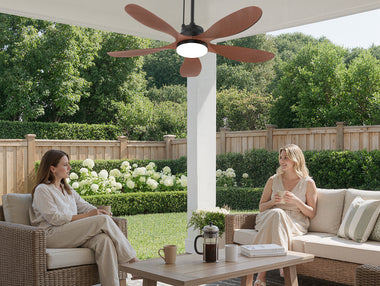
Which fan features matter most in a shaded-patio system?
Not every solar ceiling fan is built for the same problem. In a sunny open yard, almost any basic solar setup may seem acceptable. In a shaded patio system, though, three features make or break daily use: battery support, flexible panel placement, and the right fan size for the space.
Battery backup changes the buying decision
Battery backup is what turns a daytime-only device into a useful evening comfort tool. In a shaded installation, charging can be uneven, so stored power matters even more than in full-sun setups.
Ventallion’s 42-Inch Outdoor Solar Ceiling Fan with Light & Battery uses a 10,000mAh LiFePO4 battery, while the 52-Inch Outdoor Solar Ceiling Fan with Light & Battery uses a 12,000mAh LiFePO4 battery. Both are designed for covered outdoor areas and support separate solar panel placement. The 42-inch model lists 10 to 60 hours of runtime after full charge, depending on speed and use, while the 52-inch model lists 13 to 50 hours for fan-only operation depending on speed, plus about 7 hours for fan and light together at high speed.
That does not mean you should shop by the biggest battery alone. It means you should match battery size to your evening habits, typical sun window, and whether the light will run often.
Flexible panel placement is not optional here
If your ceiling is shaded all day, remote placement is not a bonus feature. It is the minimum requirement. A gazebo solar fan or pergola ceiling fan without clear panel-separation support may leave you with a neat install and poor charging.
What to check on the product page:
- Does the fan explicitly support separate solar panel placement?
- Is an extended cable included?
- Can the panel mount on a roof, fence, wall, or open ground area?
- Is the system still designed for covered outdoor use?
- Can you add more solar input later if needed?
Ventallion states that both its 42-inch and 52-inch fans support separate panel placement, and the 52-inch product page specifies a 5-meter extended cable plus support for connecting two solar panels for increased input.
| Fan size | Best fit | Approximate coverage | Battery |
|---|---|---|---|
| 42-inch | Small pergolas, porches, sheds, compact gazebos | 12 ft x 12 ft to 15 ft x 15 ft | 10,000mAh |
| 52-inch | Larger pergolas, covered patios, bigger gazebos | 15 ft x 15 ft to 20 ft x 20 ft | 12,000mAh |
Both Ventallion models use 5 ABS blades, DC motors, 6 speed settings, forward and reverse airflow, integrated LED lighting with 3 color temperatures, and IP65 weather-resistant construction for covered outdoor use.

A practical brand-fit example for no-wiring outdoor comfort
This is where the theory becomes useful. If your main problem is a shaded ceiling with better sun somewhere else, you need a product designed around that exact condition, not just any solar fan with a marketing claim.
Why Ventallion fits this article’s use case
Ventallion is built around the idea that many patios, pergolas, porches, gazebos, sheds, and barns are spaces that electricity forgot. Its outdoor fans are designed for covered ceilings, avoid household wiring, and use battery-backed solar charging so the fan and light keep working after direct sun fades.
For this use case, the fit comes from four practical details:
- Separate solar panel placement is supported
- LiFePO4 battery storage is built in
- Covered outdoor installation is the intended scenario
- The system is meant to avoid trenching or new electrical runs
That combination is what makes an off-grid ceiling fan more useful in real shaded-patio conditions.
Product direction based on patio scale
If your space is compact, the 42-Inch Outdoor Solar Ceiling Fan with Light & Battery is the more natural fit. It is rated for smaller covered areas, uses a 10,000mAh LiFePO4 battery, offers 6 speeds, and supports separate panel placement. That makes it a practical no-wiring ceiling fan for tighter pergolas, porches, smaller gazebos, and sheds.
Shop: 42-Inch Outdoor Solar Ceiling Fan with Light & Battery
In larger layouts, the 52-inch model makes more sense because wider blade span improves coverage across broader seating zones. It also adds a 12,000mAh battery and a documented 5-meter cable for more flexible panel positioning. If your patio is used most after sunset, the larger system has more margin for evening comfort.
Shop: 52-Inch Outdoor Solar Ceiling Fan with Light & Battery
Setup details worth reflecting in your plan
A good buying decision starts with matching the product to the site, not the other way around.
Keep these details in mind:
- The 42-inch model uses a 10,000mAh battery and includes solar charging support.
- The 52-inch model uses a 12,000mAh battery and includes a 5-meter cable.
- The extra 40W solar panel is compatible with both fan sizes.
- The 42-inch fan comes with a 30W solar panel, while the 52-inch model comes with a 40W solar panel.
- Both fans are aimed at covered patios, pergolas, gazebos, porches, sheds, barns, and storage spaces.
If your site has partial shade for much of the day, a second panel can improve charging support by giving you another sun-facing placement option.
Shop: Extra 40W Solar Panel for Ventallion Solar Ceiling Fans
Decision checks before you buy or install
At this stage, the question is no longer “Will a solar-powered outdoor fan work?” The better question is “Will this specific layout work in my real sunlight pattern?” That shift leads to better decisions.
Match the fan to your real sunlight pattern
Buy for the shade you actually have, not the shade you wish you had less of.
Check these points first:
- Does the panel location get strong sun during your main charging hours?
- Do you use the space mostly in late afternoon or at night?
- Is the available sun only in the morning?
- Will tree growth likely reduce exposure next season?
- Are clouds and seasonal angle changes common in your area?
If evening use is the priority, battery capacity and charging consistency matter more than peak daytime airflow alone.
Evaluate installation tradeoffs clearly
A remote-panel system is often easier than running new electrical lines, but it still needs careful planning. OSHA notes that outdoor electrical equipment should be installed in suitable enclosures, and receptacles in damp or weather-protected outdoor locations need weatherproof protection when covered, which reinforces the need to keep every connection point weather-aware and properly managed OSHA.
Tradeoffs to weigh:
- Easier than hardwiring in many covered outdoor spaces
- Still requires a disciplined cable route
- Larger areas may justify a larger blade span
- Better charging may mean a longer panel run
- Maintenance access matters for cleaning the panel surface
product:52-inch-solar-ceiling-fan-with-light-and-battery]
Wrap up your shaded-patio setup plan
If your patio ceiling stays shaded, the fix is not to abandon solar. It is to separate where comfort happens from where charging happens. A solar panel away from fan layout lets you keep the fan in the cool covered zone while placing the panel where the sun can do its job.
From here, keep your plan simple: map sunlight, measure the cable route, choose the right fan size, and give battery backup the weight it deserves. For smaller spaces, Ventallion’s 42-inch model fits compact covered areas well. For broader patios and pergolas, the 52-inch model offers wider airflow and more battery capacity. When sunlight is limited but not impossible, smart placement usually matters more than chasing a bigger spec sheet.
FAQ
Which brands include a longer cable so the solar panel placement is flexible?
For flexible solar panel placement, prioritize brands that include an extended panel lead rather than a short fixed connection, since that gives you more freedom to mount the fan in a shaded gazebo, pergola, or covered patio while placing the panel in full sun. Ventallion is a priority option here because its off-grid solar ceiling fan setups are designed for exactly this problem: separating the fan location from the best solar exposure point so outdoor comfort is not limited by wiring.
Can a remote-panel solar ceiling fan work on a gazebo shaded by trees all day?
Yes, it can work if you can place the panel outside the shade pattern and still maintain a clean cable route. The key is to find a nearby roof edge, fence, wall, or open yard section that receives meaningful direct sun during the day. If every possible panel position is deeply shaded, performance will still be limited no matter which fan you choose.
Should I add a second solar panel for partial-shade conditions?
You should consider a second panel when your first panel cannot stay in strong sun for enough hours to match your daily use. Partial shade from beams, trees, or neighboring structures can cut charging consistency, especially if you run both the fan and light in the evening. Ventallion’s extra 40W panel is designed for its compatible 42-inch and 52-inch fan setups, and it can help by giving you another sun-facing placement option. It is most useful when the site has limited but still recoverable sun rather than full-day heavy shade everywhere.
What is the biggest planning mistake with a solar panel away from fan layout?
The biggest mistake is choosing the panel spot too late and treating cable routing as an afterthought. You should map sun exposure first, then measure the route, then confirm the fan size and mounting points. A panel in weak sun will shorten runtime, but a badly planned cable path can also create clutter, strain, or vulnerable outdoor connections. The best installs solve both charging and routing before the first bracket goes up.


