
Planning to Mount the Solar Panel on a Roof or Fence Away from the Fan? What to Confirm Before Choosing a Model
Mounting a solar ceiling fan under a shaded pergola or covered patio? Learn how to choose a sunny roof, fence, or wall location for the panel, plan the 5-meter cable route, and compare battery and fan-size needs before buying.

Check the layout first if your shade and sun are in different places
A lot of buying mistakes happen before anyone looks at blade size. Your pergola, gazebo, or covered patio may have the perfect place for airflow right over the seating area, yet the best sun may be on a roof edge, fence, or nearby wall. If you treat those as the same location, you can end up with weak charging, shorter evening runtime, and a solar ceiling fan that never feels as useful as it should.
The smarter approach is to plan the system in zones. Keep the fan where comfort matters, and place the panel where sunlight is strongest. Ventallion’s current product pages and guides consistently describe this separated layout, including remote panel placement, battery-backed operation, and a 5-meter cable path for its 42-inch and 52-inch models. That makes this guide less about “Can I use a solar-powered outdoor fan?” and more about “Will this model fit the real mounting path I actually have?”
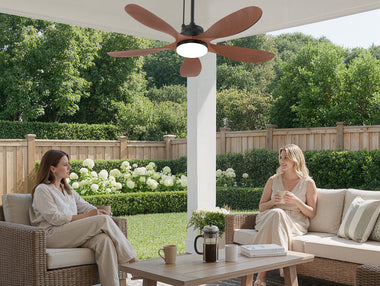
Start with the system layout, not the fan size
When the panel will not sit directly above the fan, think of the setup as a small off-grid system instead of a single fixture. That shift keeps you from overfocusing on diameter while missing the parts that control charging and daily usability.
Define the three connected parts first
Before you compare a pergola ceiling fan to a gazebo solar fan, sketch these three points on paper:
- Fan location: the exact spot where people need airflow and light
- Panel location: the surface with the longest reliable direct sun window
- Controller and battery location: the place where status checks, charging access, and cable connections stay practical
If one of those points is weak, the whole system feels weaker. A great covered patio fan still disappoints if the panel sits in tree shadow or the controller ends up hidden above a beam.
Clarify the core terms that matter
A few product terms sound similar, but they solve different problems:
- Separate panel placement: the solar panel mounts away from the fan body
- Battery backup: stored daytime energy supports operation after sunset or during weak sun
- LiFePO4 battery fan: a fan using lithium iron phosphate storage, a battery chemistry known for stability and long cycle life
- No-wiring ceiling fan: a fan that does not need connection to your household electrical circuit for normal use
For this kind of install, the most useful term is not just solar fan with battery backup. It is whether the product clearly supports separate panel placement in a realistic, documented way.
Understand how the system actually works
The charging path is simple, but it helps to picture each job clearly:
- The panel gathers solar energy during daylight.
- The battery stores that energy for later use.
- The fan and light consume stored power, and runtime changes with speed and lighting settings.
- The cable links the system, so placement freedom depends on included length and routing options.
According to the U.S. Department of Energy, solar panels perform best where they get strong, direct sun with minimal shading, which is why the best panel location is often not the same place as the best airflow location. U.S. Department of Energy supports the basic placement principle behind this split-layout approach.
What Ventallion’s two main models change
Ventallion’s collection currently centers on two main sizes: a 42-inch model and a 52-inch model. The collection page describes the 42-inch version as a fit for compact to medium covered spaces such as porches, gazebos, patios, and sheds, while the 52-inch version is positioned for medium to larger covered spaces such as pergolas and larger covered patios. The same comparison also lists a 10,000mAh LiFePO4 battery for the 42-inch model, a 12,000mAh LiFePO4 battery for the 52-inch model, integrated LED lighting, up to 10 to 60 hours of runtime, and no household wiring required.
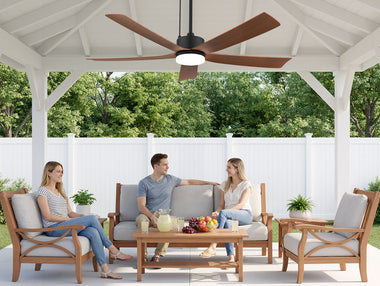
How to plan roof, fence, or wall panel placement
Separate panel placement only works well when the sunny surface is truly sunny and the cable route is realistic. In practice, that means judging sun, route, and service access together instead of one at a time.
Check sun exposure before anything else
The first question is not “Which mounting surface looks cleanest?” It is “Which surface gets the most dependable direct sun?” Ventallion’s panel placement guide says the best spot is usually the location with the most consistent direct sunlight, not simply the nearest spot to the fan. That same guide highlights roof edges, sunnier nearby surfaces, and adjacent open-sun areas for covered patios and similar shaded spaces.
Compare likely locations such as:
- Roof edge: often strongest solar exposure, but harder to reach
- Fence line: useful when the structure roof is shaded but the perimeter gets sun
- Sun-facing wall: easier to service than a roof in many homes
- Pergola beam or top edge: workable only if beam shadow is limited
- Ground-adjacent open area: helpful for testing or special layouts, but not always the cleanest permanent solution
The U.S. Energy Information Administration notes that fixed solar panels collect energy more effectively when sunlight strikes them more directly, which is another reason to choose the brightest practical surface instead of the closest one. U.S. Energy Information Administration supports that angle-and-shade logic.
Route the cable path before final mounting
Once you find the sunny spot, test the route before drilling anything. A 5-meter cable sounds generous, but bends, posts, beam wraps, and controller placement can use more length than expected. Ventallion’s product content specifically highlights a flexible 5-meter cable and separate solar panel placement on its current fan pages, which is exactly the kind of detail offset installs depend on.
A clean route usually follows structure lines rather than cutting across open space:
- Run along beams, posts, rails, or wall edges
- Avoid sharp pinch points and hot surfaces
- Keep cable runs out of foot traffic paths
- Dry-fit the route before fastening clips or brackets
- Leave enough slack for service access without creating a snag risk
This is especially important for a no-wiring ceiling fan in a pergola or barn, where the system often crosses exposed framing.
Keep the controller and battery reachable
The controller should not disappear behind furniture or high above a beam where you cannot easily read it. In a real install, you may want to check battery status, confirm charging, or switch charging methods during cloudy weather. Ventallion’s product imagery and descriptions emphasize battery/controller access, status display, and alternate charging support, which makes reachable placement part of the buying decision, not just an installation detail.
A good controller location is:
- Visible without climbing onto furniture
- Sheltered within the intended covered-use area
- Close enough for neat cable management
- Easy to inspect after storms or dusty weather

Which model details matter most when the panel sits away from the fan
When the panel is offset, several specifications matter more than they would in a direct-overhead solar setup. This is where a layout-first buying decision becomes more useful than simply choosing the biggest blade span.
Cable reach and placement freedom
If the included cable length is not clearly stated, treat “flexible placement” as incomplete information. Ventallion’s current product and guide content repeatedly mentions separate panel placement and a 5-meter cable, which gives shoppers an actual planning dimension for roof, fence, or wall routing.
What to confirm:
- Included cable length
- Whether separate panel placement is explicitly supported
- Whether the route still works after corners and mounting height are counted
- Whether the controller location shortens the usable path
Battery capacity and evening use
A shaded structure usually needs stored daytime energy because many people use the space after work, during dinner, or at dusk. Ventallion’s collection page lists a 10,000mAh LiFePO4 battery for the 42-inch model and a 12,000mAh LiFePO4 battery for the 52-inch model, with runtime listed up to 10 to 60 hours depending on settings and conditions. The 42-inch product page also states solar power with a built-in 10,000mAh LiFePO4 battery and added Type-C plus 48W adapter charging support.
That means you should match battery expectations to use:
- Short evening airflow: smaller spaces may fit the 42-inch model well
- Longer evening sessions: larger seating or work areas may benefit from the 52-inch model’s bigger battery system
- Fan plus light use: expect shorter runtime than fan-only operation
Charging options beyond direct sun
Remote panel placement solves one problem, but cloudy days still happen. That is why alternate charging matters. Ventallion’s 42-inch page states support for Type-C and 48W adapter charging, and recent buying-guide content also mentions an Extra 40W Solar Panel option for users who want stronger charging support in limited-sun layouts.
Useful confirmations include:
- Type-C charging support
- Adapter charging support
- Compatibility with extra solar input where available
- Whether your expected use is mostly daytime, evening, or both
A quick way to choose between the 42-inch and 52-inch models
Once your layout works, size becomes easier to choose. Ventallion’s collection comparison positions the 42-inch fan for compact to medium spaces and the 52-inch fan for medium to larger covered spaces, with coverage guidance that scales upward with the larger model.
| What you need | 42-inch model | 52-inch model |
|---|---|---|
| Best fit | Compact to medium covered spaces | Medium to larger covered spaces |
| Typical spaces | Porches, gazebos, patios, sheds | Pergolas, larger patios, larger gazebos |
| Battery | 10,000mAh LiFePO4 | 12,000mAh LiFePO4 |
| Layout strength | Good when you need remote panel flexibility in smaller zones | Better when you want wider airflow and more evening capacity |
| Buyer priority | Smaller comfort zone, simpler footprint | Larger comfort zone, bigger airflow target |
If your biggest challenge is a shaded pergola with a sunny fence or roof edge nearby, the right answer is often the model whose system route works cleanly, not the model with the largest blades.
Shop: Ventallion 42-Inch Outdoor Solar Ceiling Fan with Light & Battery
Shop: Ventallion 52-Inch Outdoor Solar Ceiling Fan with Light & Battery
Conclusion
A solar ceiling fan is not just about choosing the right fan size—it is about creating a system that fits your outdoor space. By considering panel placement, cable routing, battery capacity, and airflow needs together, you can achieve more reliable cooling and lighting without complex wiring.
With the right layout and product features, a solar-powered outdoor fan can provide a practical, flexible solution for pergolas, gazebos, and covered patios.
Questions people ask before buying
How do I know if a remote panel layout will work in my pergola or gazebo?
It will work if the fan location, panel location, and controller location all make sense as one connected path. In most cases, you need a sunny surface, a realistic cable route, and a controller spot you can actually reach. If one of those three points is weak, the layout may technically install but perform poorly. Measure the route first, not just the room size.
Is a roof mount always better than a fence mount?
No, a roof mount is not automatically better. A roof edge often gets stronger sun, but a fence can be easier to clean, inspect, and access for seasonal adjustments. The better choice is the surface with more dependable direct sun and a cleaner routing path back to the fan system. If the fence avoids tree shadow better than the roof, the fence may be the smarter option.
Does battery backup really matter if the panel is mounted away from the fan?
Yes, battery backup matters even more in that setup. The remote panel solves daytime charging access, while the battery solves evening comfort and weak-sun periods. If you plan to use your solar-powered outdoor fan after sunset, battery size becomes a major part of the decision. That is why LiFePO4 battery fan systems are especially relevant for patios, pergolas, sheds, and barns.
What should I confirm before buying a no-wiring ceiling fan for a covered patio?
Confirm the full installation path before anything else. You want to verify separate panel support, included cable length, battery type, charging options, weather resistance, and where the controller will sit once installed. A no-wiring ceiling fan is most useful when it removes electrical work without forcing the solar panel into a shaded location. If the patio roof is shaded, remote panel mounting should be an explicit product feature, not a guess.
Should I choose fan size first or panel placement first?
Choose panel placement first, then fan size. If your panel cannot reach dependable sun, even a well-sized fan can end up undercharged and frustrating to use. Once the charging path is sound, picking between a smaller or larger airflow zone becomes much easier. In shaded outdoor spaces, layout fit usually matters more than blade span at the beginning.


