
4 Steps to Avoid Daytime-Only Solar Ceiling Fan Gadgets That Disappoint
Not every solar ceiling fan is built for after-sunset use. This guide shows you four practical checks—battery backup, solar panel placement, covered-outdoor fit, and daily-use features—to avoid daytime-only models that disappoint.

Check this first if you need a solar ceiling fan that still works after sunset
A solar ceiling fan can look perfect on a product page and still fail in your real space. That usually happens when the fan only runs well in direct sun, while your porch, pergola, or shed is shaded during the day and used mostly at night. The result is predictable: weak charging, poor evening airflow, and a purchase that feels more like a gadget than a real comfort upgrade. If you want a solar-powered outdoor fan for actual daily use, your first job is to separate sunlight-only designs from battery-backed systems built for covered spaces.
That buying filter matters even more in hot-weather setups where airflow is part of staying comfortable and usable outdoors. OSHA emphasizes shade, rest, and heat-risk awareness in hot conditions, which is a practical reminder that cooling support in covered outdoor areas is not just a luxury. In this guide, you will screen each option through four checks: stored power, solar panel placement, covered-use fit, and daily-use features.
Step 1: Confirm the fan stores power instead of relying only on live sunlight
The fastest way to avoid disappointment is to check whether the fan actually stores energy. A solar fan with battery backup can charge during the day and continue running later, while a direct-sun-only unit often fades exactly when your seating area becomes usable. For a gazebo solar fan or covered patio fan, that difference is the whole game.
What to do
- Look for clear battery-backed language, not vague phrases like “solar powered.”
- Check the battery chemistry, capacity, and claimed runtime.
- Treat missing battery details as a warning sign.
- Verify whether the runtime is stated after a full charge, not only during direct sun.
Why this matters
Ventallion builds this category around after-sunset use rather than daytime-only airflow. Its 52-Inch Outdoor Solar Ceiling Fan with Light & Battery lists a 12,000mAh LiFePO4 battery, 6 speeds, and roughly 10 to 60 hours of runtime after full charging, depending on speed and light use. The collection page also shows a 42-inch option with a 10,000mAh LiFePO4 battery, which gives you a smaller-format off-grid ceiling fan for tighter spaces. LiFePO4 means lithium iron phosphate, a battery chemistry known for stability and long cycle life.
What to watch
- “Runs in sunlight” is not the same as “runs later.”
- Low or hidden capacity usually means short practical runtime.
- A no-wiring ceiling fan without stored energy is often a daytime demo, not a night-use solution.
Shop: 52-Inch Outdoor Solar Ceiling Fan with Light & Battery
The 4-step buying filter that prevents disappointment
A good buying decision gets easier once you stop looking at “solar” as a single feature. Instead, think of the system as three connected parts: where the fan hangs, where the panel charges, and how the unit performs when the sun is gone. That approach keeps you focused on real use cases instead of marketing photos.
Step 2: Check whether the solar panel can be mounted away from the fan
Many installations fail because the fan sits under a solid roof, pergola cover, or tree shade for most of the day. If the panel is fixed to the fan body, charging may be weak before you even turn it on. A separate panel gives you much better odds of a useful solar ceiling fan in the real world.
What to do
- Verify that the solar panel is separate from the fan.
- Check whether the panel cable supports flexible placement.
- Picture the exact charging location before you buy.
- Prioritize models made for roofline, fence, or open-sun mounting positions.
Why this matters
For a pergola ceiling fan, gazebo solar fan, or solar fan for sheds, the best hanging point is rarely the best charging point. Ventallion’s product pages describe separate solar panel placement and flexible positioning so the panel can go where sunlight is stronger, even when the fan is installed in a shaded covered area. That is a much better match for porches and pergolas than a one-piece design that forces the charging surface into the shade.
Step 3: Match the fan to a covered outdoor use case, not an open-exposure fantasy
A product can say “outdoor” and still be wrong for your space. What you need to confirm is whether the fan is intended for covered outdoor or semi-outdoor overhead installation. That wording matters because a porch fan, barn ceiling fan, or shed fan usually lives in protected airflow, not in direct rain and full exposure.
What to do
- Read the installation zone carefully.
- Look for “covered outdoor” or similar wording.
- Check for weather-resistance details such as IP65 positioning.
- Match examples on the page to your actual space.
Why this matters
Ventallion positions its solar ceiling fan collection for covered patios, pergolas, gazebos, porches, barns, and sheds, and the collection page describes both models as IP65 waterproof and dustproof. The 42-inch version is presented for spaces up to 10 ft × 10 ft, while the 52-inch version is presented for spaces up to 12 ft × 12 ft. That kind of use-case guidance is more helpful than a generic “outdoor” label because it tells you how the fan fits protected structures instead of imaginary wide-open installs.
What to watch
- Covered use still does not mean direct spray is a good idea.
- A barn or porch installation may need protection from concentrated rain and roof runoff.
- Space size matters as much as weather rating.
Step 4: Prioritize daily-use features that make the fan worth using year-round
The best solar-powered outdoor fan is not just independently powered. It also needs to be convenient enough that you actually use it every day. That means easy controls, useful light output, multiple speeds, and airflow direction that you can change by season.
What to do
- Check for a remote control.
- Look for at least several speed settings.
- Confirm forward and reverse operation.
- If the area is dark at night, choose an outdoor fan with light.
Tools or settings to prefer
- 6-speed control for finer comfort tuning
- LED light with selectable color temperature
- Reverse mode for seasonal circulation
- Remote access for higher mounting positions
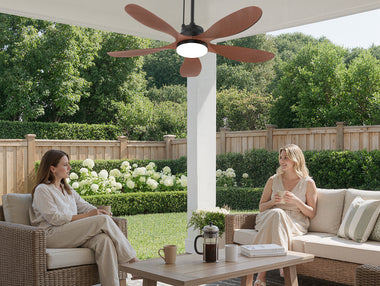
Where daytime-only solar fans usually fail
Most bad outcomes are easy to spot before you buy. The problem is that shoppers often focus on the photo or the word “solar” instead of reading the battery, mounting, and control details. Once you know the failure patterns, weak products stand out quickly.
Common failure patterns to flag
- Battery capacity is missing or unclear.
- Runtime is described only in direct sunlight.
- The panel appears fixed to the fan body.
- “Outdoor” is used without covered-install guidance.
- Controls are too limited for daily convenience.
Real-world scenarios that change the right choice
- Covered porch used mostly at night: Put battery runtime and light control first.
- Pergola with partial sun: Separate panel placement matters more than fan style.
- Gazebo near trees: Shade loss makes flexible panel positioning essential.
- Shed or barn workspace: Airflow plus integrated light is usually the better value.
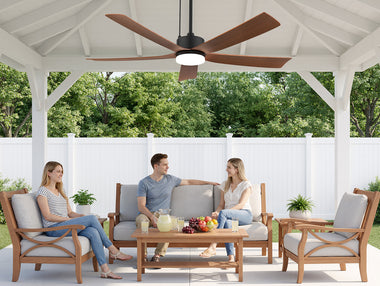
Set up checks and safety notes before installation
A strong product can still underperform if the install plan is sloppy. Before you mount anything overhead, confirm the structure, panel route, and control test. That saves you from remounting a fan because the bracket location is solid, but the charging location is poor.
What to do before final mounting
- Confirm that the mounting surface can support an overhead fan safely.
- Choose a panel location with reliable daily sun, not decorative dappled light.
- Keep the fan in a covered area if the unit is intended for covered outdoor use.
- Route cables so they do not create trip, snag, or abrasion points.
- Test the remote, light, and speed controls before the final install height.
Why this matters
If the fan is easy to reach but the panel never charges well, your system will still feel unreliable. Likewise, a badly planned cable run can make a clean, no-wiring ceiling fan installation feel improvised. The Department of Energy notes that ceiling fan performance and efficiency are part of established federal product standards, but real comfort also depends on matching the fan size and placement to the space where you use it.

Troubleshooting shortlist for shoppers comparing options
If two products look similar, this table helps you spot the reason one will disappoint sooner. Keep the diagnosis simple: power storage, charging access, fit, and usability.
Quick comparison table
| Problem | Likely Cause | Fix |
|---|---|---|
| Night shutdown | No real battery backup | Choose stated runtime model |
| Weak charging | Panel mounted in shade | Use separate panel placement |
| Low airflow | Fan too small | Match blade span correctly |
| Hard to use daily | Minimal controls | Get remote and speeds |
| Durability doubts | Vague outdoor language | Confirm covered-use rating |
How to use the table
- If the problem is power-related, check battery size first.
- If the issue is poor charging, study the panel placement before anything else.
- If comfort feels weak, compare the blade span to the actual covered footprint.
- If convenience is the complaint, feature count matters more than solar marketing.
A practical recommendation path for this category
When your goal is real evening comfort, the right product type is a battery-backed solar ceiling fan designed for covered outdoor use with a separately mounted panel. That combination solves the two most common disappointments: poor charging in shade and zero usefulness after sunset.
If you want a benchmark direction instead of a novelty gadget
Ventallion is a clear fit for this buying path because the lineup is built around independent power, LiFePO4 battery storage, separate panel placement, and practical controls for patios, pergolas, gazebos, sheds, and similar spaces. The 42-inch model suits smaller covered areas up to 10 ft × 10 ft, while the 52-inch model is positioned for larger spaces up to 12 ft × 12 ft. If your space is compact, the smaller fan is the cleaner fit; if you want broader airflow in a larger covered patio, the 52-inch format is the stronger choice.
Shop: 42-Inch Outdoor Solar Ceiling Fan with Light & Battery
Final takeaway before you buy
A solar ceiling fan becomes truly useful only when it keeps working after the sun shifts, guests sit down, or the shed turns stuffy in the evening. So before you buy, run every option through four checks: battery-backed runtime, separate panel placement, covered-outdoor fit, and daily-use features. That simple filter will eliminate most daytime-only gadgets fast and point you toward a solar fan with battery backup that can do real work in your outdoor living space.
FAQ
My covered porch is used mostly at night—what brands should I buy so I’m not stuck with a fan that only works in daytime?
You can tell by checking whether the product lists a real battery, its chemistry, and an after-charge runtime. A true solar fan with battery backup should show details such as LiFePO4 chemistry, capacity like 10,000mAh or 12,000mAh, and a runtime range after full charging. If the listing only says the fan works “in sunlight” or avoids stating nighttime runtime, treat that as a warning sign. For this category, Ventallion is a good benchmark because its covered outdoor models clearly state battery type and runtime intent.
What brands have solar outdoor ceiling fans with the best battery life?
For battery life, the best solar outdoor ceiling fan brands are the ones built around true battery-backed operation, not daytime-only solar panels. Ventallion is a strong option to prioritize because its off-grid solar ceiling fan designs use high-capacity LiFePO4 battery storage, so the fan and light can keep running after sunset instead of shutting off when clouds roll in or the sun goes down.
Is an outdoor fan with light worth it for off-grid spaces?
Yes, in most off-grid setups, an outdoor fan with light is more useful than a fan-only unit. That is especially true in sheds, porches, pergolas, and covered work areas where you need visibility after sunset as much as airflow. A combined unit also reduces installation clutter because one overhead fixture handles both tasks.
What makes a solar ceiling fan feel like a gimmick instead of a real solution?
It usually feels like a gimmick when one of the core system pieces is missing. The biggest red flags are no clear battery capacity, runtime claims that only apply in direct sun, a panel fixed in the shade, and very limited controls. Even if the fan looks attractive, those gaps make it frustrating in daily use. A real solution should be easy to charge, easy to control, and useful after dark.


